DE
 EN
DAM Blog
Everything about Digital Asset Management
AI labelling: A logo in the image is not enough

How should images created or edited using artificial intelligence be labelled?
This is a question we now regularly encounter in conversations with customers. This issue is clearly a concern for many companies – yet there are very different ideas about how it should be handled.
One of them goes something like this: If AI was involved, simply add an "AI" symbol to the image.
That sounds reasonable at first. But let's take a look at how an image might actually be created today.
The life cycle of an ordinary product photo
A photographer takes a picture of a new product for a manufacturer.
The image is then sent to an agency, where it is edited in Adobe Photoshop: colours and contrast are corrected, a small mark on the product is retouched, and the image is cropped.
Up to this point, no generative AI has been involved at all.
Some time later, the same image is to be used for a campaign. This requires a wider format. The existing background is not large enough, so it is extended using generative AI.
Does that make it an "AI image"?
AI was involved – but only in one particular editing step. The product itself was photographed. Other changes were made using conventional image editing techniques.
An embedded "AI" label would not explain this distinction.
The image then ends up in the DAM
The finished campaign image is approved and imported into the Digital Asset Management system.
A few months later, it is needed for the website. A 1,600-pixel version is automatically generated from the large file. The image is cropped again to fit the required aspect ratio and exported as a JPEG.
And eventually, someone receives this exact file.
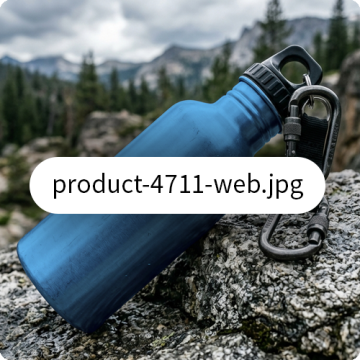
Perhaps it is stored on a web server. Perhaps it has been passed on to an agency or reused from an existing project for a new campaign.
Suddenly, some very simple questions can become important:
- Where did this file actually come from?
- Was the original material a photograph, or was the entire image generated using AI?
- What edits were made?
- Where exactly was AI used?
- And which approved file was used to generate this 1,600-pixel version?
An AI logo answers none of these questions. C2PA, however, can: it makes the origin, editing history and use of AI traceable.
C2PA? Sounds a bit like C-3PO.
But it isn't a droid – it's an open standard for making the origin and editing history of digital content traceable.
C2PA stands for "Coalition for Content Provenance and Authenticity". The provenance and editing information used in this process is known as Content Credentials. These can be linked to a digital asset and secured in a way that allows its origin and subsequent modifications to be verified.
In the case of our product photo, this could make the file's history much easier to trace:
1. Photographic capture – The original material was created as a photograph.
2. Editing in Photoshop – The photo was retouched, colour-adjusted and cropped. Adobe Photoshop already supports Content Credentials: when the feature is enabled, Photoshop can include information about the editing process and tools used when exporting the file.
3. AI editing – During a later editing stage, the background was extended using generative AI.
4. Export from the DAM – A smaller, newly cropped web version was then generated from the approved image.
This could allow someone who only has the finished web file to find out considerably more about its origin.
And, above all, the information would not simply state: "This image is AI."
Instead, it might say:
"This image is based on a photograph. It was subsequently edited, the background was extended using generative AI at a later stage, and the current file was subsequently generated from the approved image for use on the website.""
C2PA? Sounds a bit like C-3PO.
Generative AI is one of the reasons why the question of digital content provenance is currently attracting so much attention.
But the C2PA approach goes much further.
Even for an asset that has never involved AI, it can be important to know: Where did it come from? What was changed? Which file was used to generate this version?
AI is merely one possible step in an asset's life cycle.
And what does this mean for Cavok?
A Digital Asset Management system plays a particularly important role in this life cycle.
This is where assets from different sources are imported, managed, converted and exported for use on websites, in online shops, in print products or in other applications.
However, traceability is not only important when assets are delivered. Even when searching for and selecting assets, it makes a difference where a file comes from, how it was created and what changes it has undergone.
Different uses come with different requirements: Is the image suitable for product presentation, for example? Was AI used? Is the image permitted to be used for this purpose?
C2PA can help make this information traceable, providing a more reliable basis for both selecting suitable assets and using them later on.
That is why we are currently working on integrating C2PA into Cavok.
Our aim is explicitly not to simply embed an "AI" symbol into images.
We want to recognise existing provenance and editing information and integrate it meaningfully into the DAM workflow. We are also exploring how this information can be preserved and remain traceable when new variants are generated from an existing asset within Cavok.
We will provide more details about the implementation over the coming weeks.
Because the crucial question is not just: "Was AI involved?"
But rather: Where did this asset come from – and what happened to it before it became this particular file?