 DE
DE  EN
EN DAM Blog
Everything about Digital Asset Management
How professional photography and data protection work together: A practical example from the trade fair industry

Trade fairs are fast-paced. People stop by, move on, have conversations and explore exhibition stands – and in those moments, photographs are taken.
Wherever people are photographed – at trade fairs, events, for press purposes or marketing – the same questions keep coming up:
Which images may be used? Which images may not? What may they be used for? How does data protection come into play? And how can all of this be documented properly?
A customer from the trade fair industry faced exactly these challenges. Together with PEAK-14, they developed a workflow in Cavok that provides a reliable solution.
When photographs become a legal matter
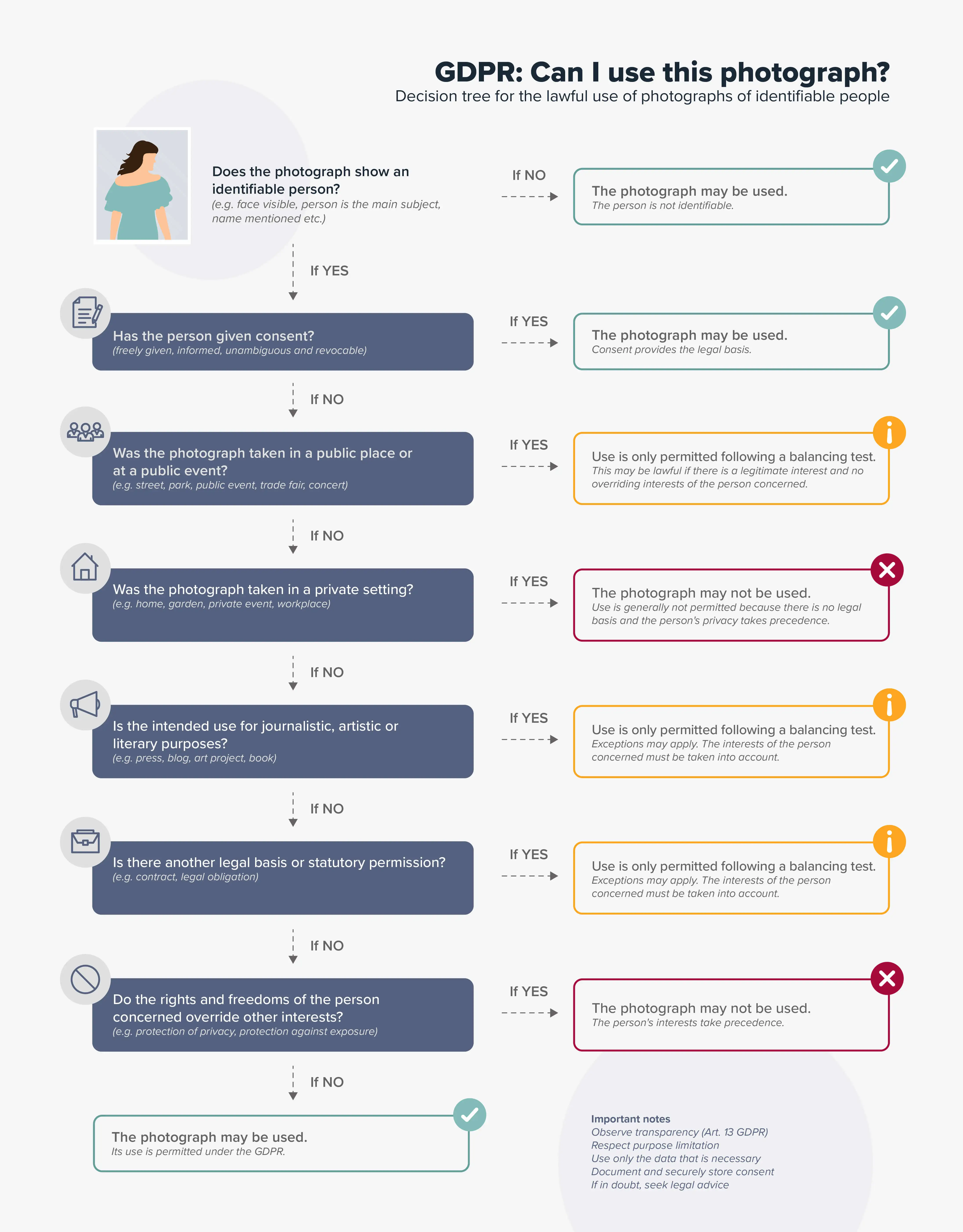
As soon as people are photographed, a number of rules apply:
- Is a person clearly identifiable? → Consent for publication is required.
- Will the image be used (e.g. for marketing purposes)? → The consent must be documented.
- Will it be shared with third parties? → Proof of consent must be available.
This is exactly where things become challenging in practice, as there is a common misconception:
A simple notice saying 'Photography is taking place' is enough.
In many cases, it is not.
Whenever photographs are taken deliberately or later used in print, on websites, on social media or for press purposes, explicit, legally valid consent is required.
The reality: Time pressure, multiple stakeholders and unclear responsibilities
At trade fairs and other events, many different parties work together:
- photographers (in-house or freelance)
- service providers
- clients
But who is actually responsible for obtaining consent for the use of photographs? In practice, this responsibility is often passed from one party to another.
As a result,
- consent is missing,
- documentation is incomplete, or
- images cannot be clearly linked to the people shown.
And when in doubt, one principle applies: No consent → no use.
The real challenge: An efficient process
The challenge is not only legal but, above all, organisational.
The process must:
- work quickly during a live event,
- comply with legal requirements,
- document consent clearly, and
- remain fully traceable afterwards.
After the event, questions such as these arise:
- Which images are we allowed to use?
- Which channels may they be used on?
- And do we have the necessary proof?
Typical use cases in practice
The complexity of these situations often only becomes apparent in day-to-day work. Different consent preferences, several people appearing in the same image or consent being withdrawn at a later stage can quickly create uncertainty.
The following examples illustrate common scenarios and show how they can be managed with a structured workflow.
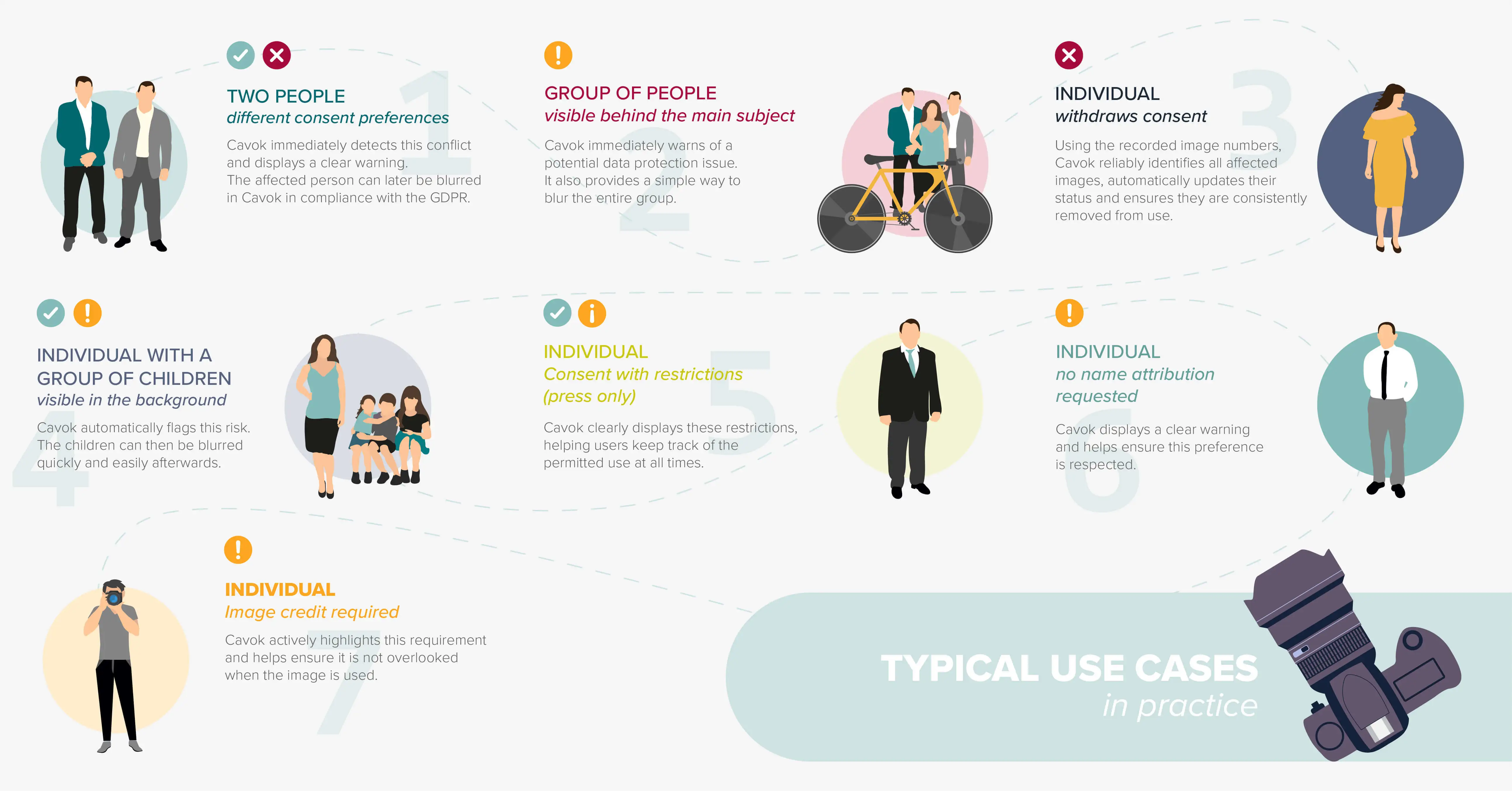
What matters most is not any single situation, but the ability to manage many different scenarios consistently in everyday work.
This is where the value of a clearly structured process becomes apparent: it helps organisations stay in control and make confident decisions.
Why this matters to many organisations
These examples show that this challenge is not unique – it affects many organisations that work with images of people.
Ultimately, they all face the same issues: time pressure, legal requirements and organisational complexity.
The solution:
A seamless workflow for images and consent
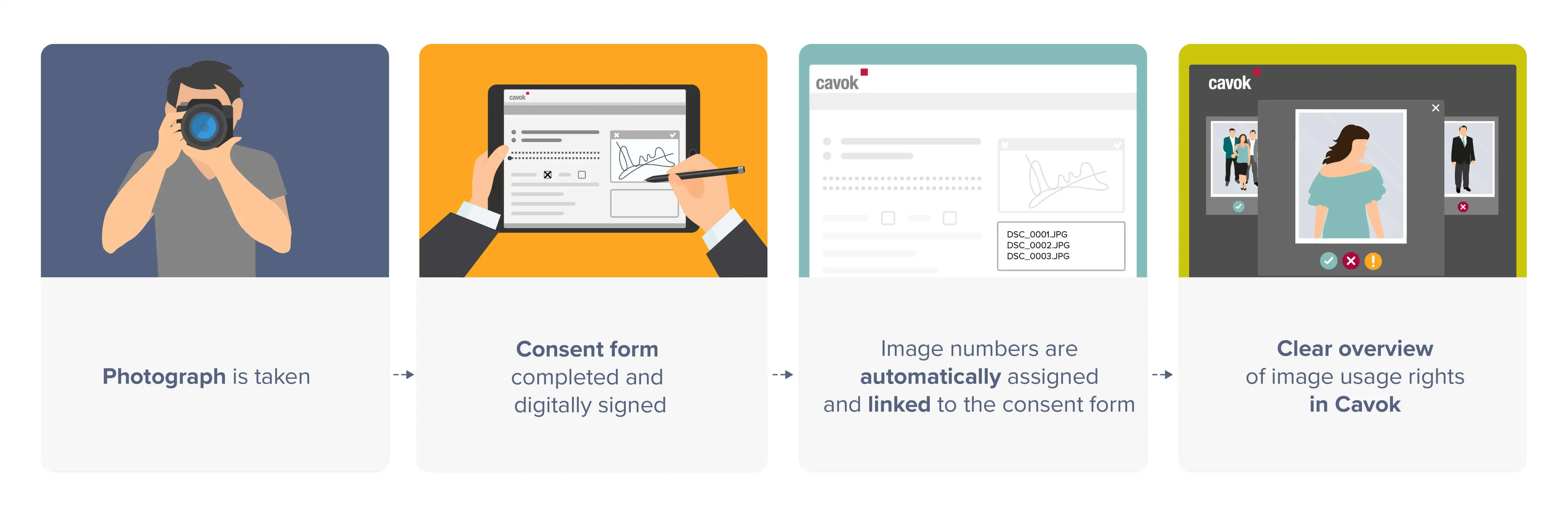
Together with PEAK-14, a workflow was developed in Cavok that solves the customer's challenge from image capture through to final use.
The process can be divided into three steps:
1. Capture consent on site
Consent is collected where the photographs are taken using a digital form:
- The photographer takes the picture.
- The intended use of the image is recorded, and the person photographed signs the form digitally on a tablet.
- Image numbers are automatically assigned in Cavok and linked to the form.
The process is fast enough for the pace of a trade fair while ensuring that all relevant information is documented from the very beginning.
2. Automatically link images and consent
Once the images have been uploaded, Cavok automatically takes care of the next steps in the background:
- Extracting the information from the consent forms,
- assigning image numbers to the people shown, and
- linking images and consent forms using Cavok's stacking feature
Photographer → Consent form → Cavok → Image assignment → Image use
3. Control image use – without the risk
A key point is that not every image can be used in the same way.
In Cavok, each customer can make this instantly visible using a customised visual status system, for example:
🔴 No consent → blocked
🟡 Consent with restrictions → limited use
🟢 Consent available → approved for use
Restrictions may include:
- use limited to specific channels (e.g. online, print or social media)
- an expiry date
- requirements regarding name attribution
The traffic light system removes any uncertainty about which images can be used and under what conditions.
What happens in critical situations?
These situations are also part of everyday practice:
- A person does not want their image to be published → the image is not used.
- An image contains sensitive content → selected areas can be blurred.
- Consent is withdrawn → the affected images are reassessed and, if necessary, blocked.
Important:
Cavok supports the workflow, but it does not replace human decision-making.
The result: Structure instead of uncertainty
The workflow transforms what was once a difficult-to-manage process into one that is clear, structured and reliable.
- Consent is documented.
- Images are clearly assigned.
- Image usage is fully traceable.
- Risks are reduced.
And most importantly:
The question "Are we allowed to use this image?" can finally be answered clearly and in compliance with the GDPR.
Final thoughts: GDPR-compliant photography starts with a structured process
What once seemed like an almost impossible challenge – managing GDPR-compliant photography at trade fairs and events in real time – can be handled through a well-designed workflow in Cavok.
Not by adding more rules, but by creating better, clearly structured processes.
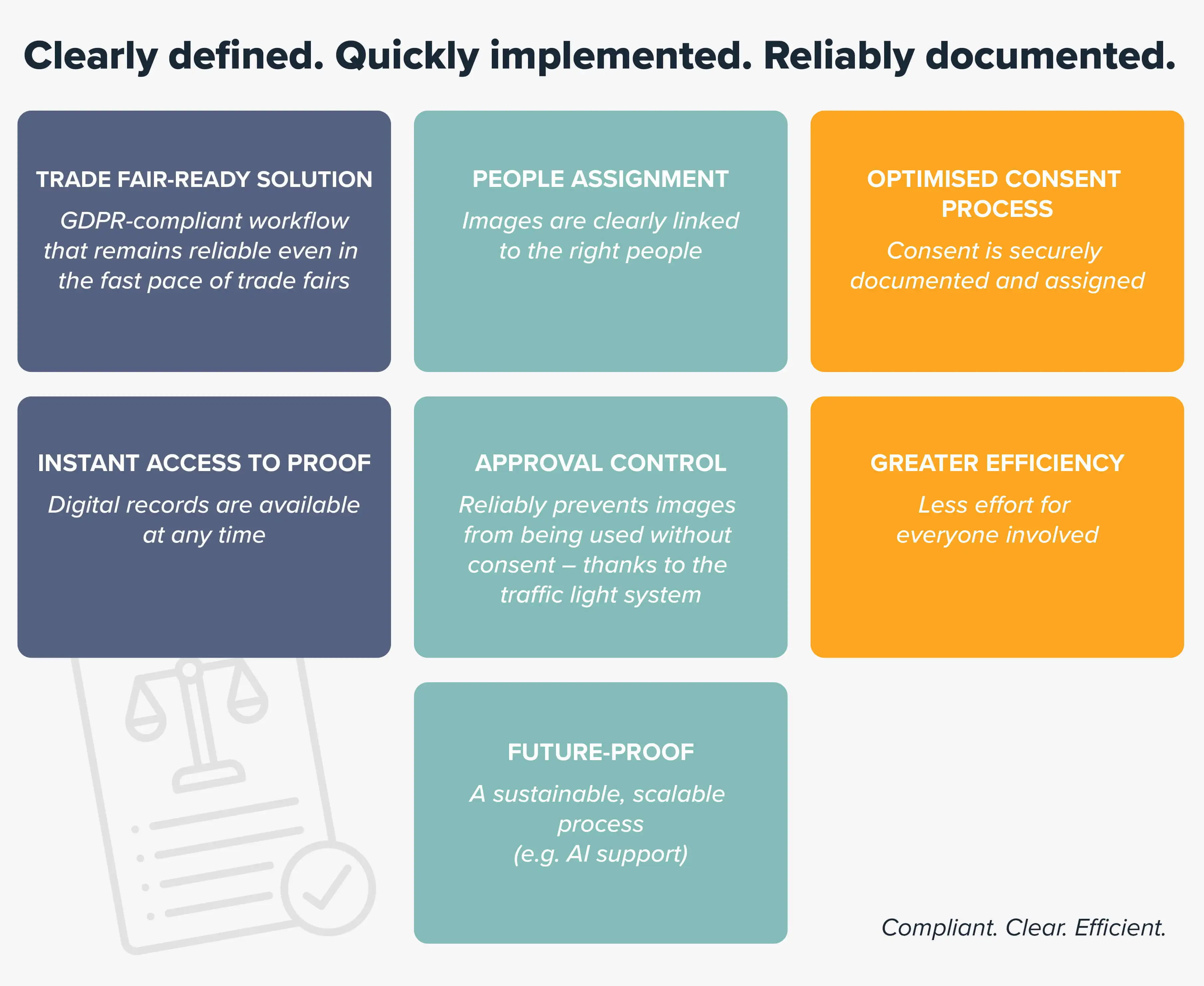
Are you facing similar challenges when managing image rights and consent?
Get in touch with us – we'd be happy to show you how a tailored workflow can work for your organisation.